
🌟 Go Big or Go Home: Why 2025 Is the Year to Supercharge Your Charitable Giving.
🫶🏻 Why Philanthropy Needs to Be on Your 2025 To-Do List
If you’ve been considering a major charitable gift, this is your year.
The One Big Beautiful Bill Act (OBBBA), signed in 2025, brings sweeping tax changes that take effect in 2026 — and many of them could shrink the deductions available to high-income givers. For philanthropically minded women, entrepreneurs, and families, 2025 is the last full year to give big under the most favorable tax environment we’ve seen in years.
This isn’t just about generosity; it’s about strategy. Smart, values-aligned giving can reduce your tax bill, increase your impact, and engage your family in a shared legacy of purpose.
At Green Bee Advisory, we call this “Philanthropy as a Tax-Smart Investment.”
Because when done thoughtfully, charitable giving can yield measurable results — for your community, your family, and your long-term wealth plan.
⭐️ Why Donor Advised Funds (DAFs) Are the Star Players
A Donor-Advised Fund (DAF) is like a charitable investment account. You contribute cash or appreciated assets, receive an immediate tax deduction, and then recommend grants to your favorite nonprofits over time. Further, your contributions can be invested for growth. If the account value grows, this can allow you to make even larger donations over time.
DAFs continue to grow in popularity because they offer:
· Ease and flexibility: A single account for all your giving — no more writing multiple checks or tracking receipts.
· Immediate tax benefits: Deduct your contribution in the year you give, even if you decide where to donate later.
· Long-term impact: 90% of assets contributed to DAFs are granted within 10 years, and most donors make about 12 grants per year, averaging $5,000 each.
· No ongoing tax filings: Unlike private foundations, DAFs don’t require annual reporting or excise taxes.
DAFs are also powerful family tools. You can name your children or grandchildren as successor advisors, turning charitable giving into an intergenerational legacy project.
🗓️ The 2026 Cliff: What the OBBBA Changes Mean to you – and why TODAY is the day for your Donor Advised Fund
The OBBBA preserved many provisions from the 2017 Tax Cuts and Jobs Act but introduced new limits that hit high-income donors especially hard, starting in 2026.
Here’s what’s on the horizon:
· New 0.5% floor on charitable deductions for individuals — smaller donations may no longer qualify.
· 60% AGI limit on cash gifts remains, but a new 35% cap on total itemized deductions (down from 37%) begins in 2026.
· Above-the-line deduction of $1,000 (single) or $2,000 (joint) for public-charity cash gifts only — excluding DAFs.
· 1% minimum corporate giving rule in 2026.
· And possibly most impactful: an end to full unlimited carryforward flexibility for excess charitable deductions (pending IRS guidance).
Bottom line: If you delay large gifts until 2026, your deduction could shrink substantially.
This is the year to GO BIG or GO HOME.
🍇 Bunching: The Smart Way to Maximize 2025 Deductions
Tax filers are often not familiar with this tax efficient donation strategy.
If you typically give $10,000–$25,000 per year, you may not itemize deductions because of today’s high standard deduction ($29,200 for joint filers in 2025).
But with gift-bunching, you can make multiple years of donations in a single tax year, qualify for itemization, and boost your deduction for this year.
Example:
You give $20,000 each year for three years. If you instead contribute $60,000 to a DAF in 2025, you’ll deduct the full amount this year — before the OBBBA’s new floors and caps kick in — and still grant $20,000 annually to your favorite causes in 2026 and 2027.
That’s efficient giving.
⚠️ Advanced Strategies: Complex Assets and “Unusual” Donations
For those experiencing liquidity events — business sales, real estate transactions, or IPOs — timing is everything.
By donating assets instead of selling to cash and THEN donating, you can deduct the fair market value and avoid capital gains tax entirely. Most DAFs easily accept stock and cash donations. However, even if you have unconventional assets, including: Private company or LLC shares, restricted stock, real estate, and even digital assets, there are platforms that exist to help donors through the giving process. My estate planning attorney said she once helped a client donate ½ of a cruise ship!
🤔 Private Foundations vs. DAFs:
What’s the Right Fit?
Both structures can support meaningful giving, but they serve different purposes.
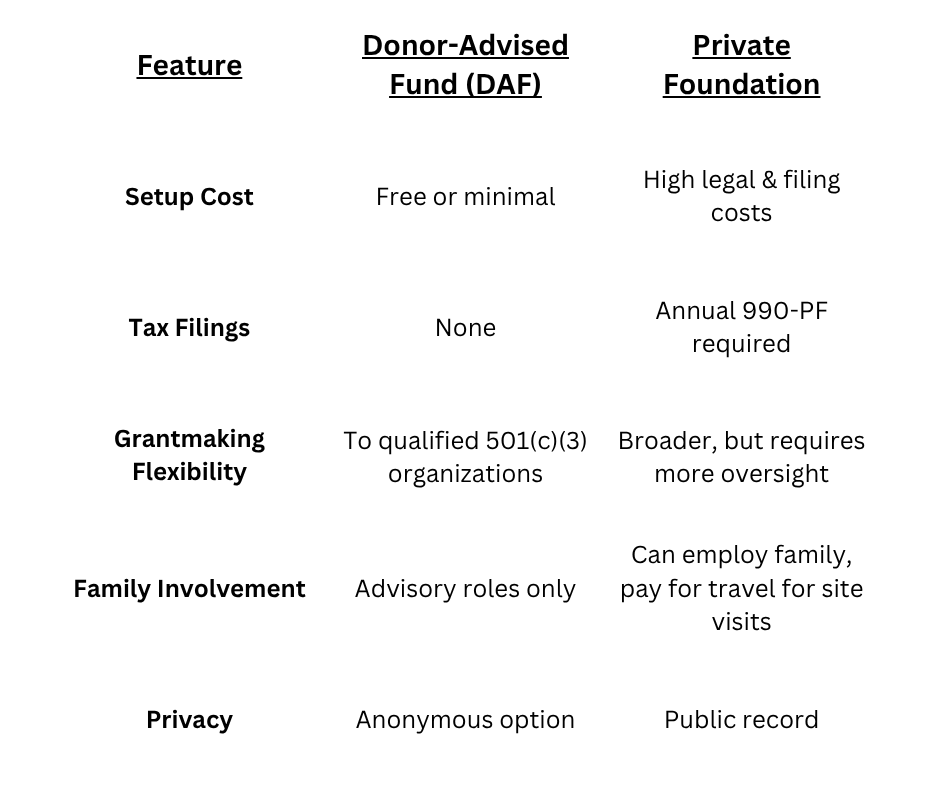
For most high-earning families seeking simplicity, DAFs offer 90% of the impact with 10% of the paperwork.
📐 Philanthropy as an Investment:
Measuring Impact
Increasingly, donors aren’t just giving — they’re investing in impact.
Whether you’re contributing $10,000 or $1 million, it’s natural to ask: What has my gift done?
That shift — from emotional giving to intentional impact — is reshaping philanthropy. Families now measure success not only in dollars given, but in outcomes achieved: scholarships funded, land conserved, women-owned businesses supported.
Philanthropy today is a strategic pillar of wealth management — aligning your resources with your values while optimizing your tax efficiency.
👵🏽 The Multigenerational Moment
We’re on the cusp of one of the largest wealth transfers in history. Gen X will inherit the first major tranche of assets from Boomers. If you have not yet thought about how you’ll engage your family in philanthropy, here are some ideas:
· Create a philanthropic mission statement. Define your “why” for giving.
· Host a family giving night. At Thanksgiving, have each family member pitch a cause. Vote, or support all of them!
· Add successor advisors to your DAF. Empower your children to make grants in your honor.
· Fidelity Charitable has created a great Family Forward Guide to spark values-based conversations.
It’s not just about legacy — it’s about joy. The joy comes from seeing your philanthropic dollars being put to good use – and measuring actual outcomes. That feels amazing for both you and the recipients.
💥 A Note on Large Endowments and the Small Donor Boom
The OBBBA also tightened rules for large university endowments, which may prompt these institutions to rethink their giving models — and could open the door for a larger base of smaller donors.
That’s good news. As more people adopt DAFs and digital giving platforms, philanthropy becomes more democratized. You don’t need to have millions to be strategic — you just need a plan.
🎁 Key Takeaways for 2025:
Act Early, Think Big, Give Smart
1. Give before 2026 — floors and caps will reduce deductions next year.
2. Bunch contributions to lock in 2025 benefits.
3. Use a DAF for simplicity and family engagement.
4. Donate low cost basis and complex assets to avoid capital gains.
5. Review deadlines now for timely processing.
〰️ The Bottom Line
2025 is a pivotal year for charitable strategy. Between the looming OBBBA deduction limits, rising interest in measurable impact, and opportunities to engage the next generation, there’s never been a better time to align your giving with your goals. Schedule a discovery call at GreenBeeAdvisory.com/contact to create a philanthropic strategy to enhance both impact and tax efficiency.
📲 Call to Action: Let’s Plan On It
✨ Schedule your Tax & Wealth Strategy Session
Let’s uncover missed deductions, plan smarter income strategies, and align every dollar with your goals.
🐝 FAQ: Smart DAF & Charitable Giving Strategies for High Earners
Why is 2025 a pivotal year for using a Donor-Advised Fund (DAF)?
The tax law changes under One Big Beautiful Bill Act (OBBBA) take effect in 2026 — including deduction floors, lower AGI limits, and reduced carryforward flexibility. High-net-worth donors can lock in favorable tax deductions by funding a DAF in 2025, then grant to charities over time.
How can I use “bunching” with a DAF to maximize tax benefit?
With bunching, instead of donating the same amount each year, you deposit several years’ worth into a DAF in one year (e.g., 2025) to get itemized deduction this year, then make grants later. This is especially powerful before new deduction limits take effect in 2026.
What types of assets should I donate to a DAF for maximum efficiency?
Instead of cash, consider donating low-basis or highly appreciated assets (stocks, private company shares, real estate, digital assets) so you avoid large capital gains tax and claim full fair market value. Especially smart when you anticipate a liquidity event or large gain.
How should I engage family in my philanthropic legacy via a DAF?
Many high-earners name children or grandchildren as successor advisors on the DAF, host “family giving nights,” or create a mission statement so the DAF becomes a multigenerational vehicle—not just for tax savings, but values and impact.
What should I do now to ensure my DAF strategy is executed smoothly?
Start by modeling your income, deductions, and potential giving over the next 3-5 years. Then fund the DAF in 2025 (before the deduction rules change) with a written grant plan, coordinate with your tax advisor for timing, and confirm the DAF accepts the asset types you plan to donate.
This material is for educational purposes only.
Always consult with your legal and tax advisors.