
Business Owner Tax Strategies: Entity Choice, Deductions & Year-End Planning
Getting a business off the ground is one thing. Running a business producing $1 million, $5 million or $10+ million of annual revenue is something entirely different.
Yet plenty of successful business owners are still using the tax structure and financial systems they put in place when the company was much smaller. That's where opportunities can get missed.
As your business grows, tax planning becomes less about finding another deduction and more about coordinating a series of decisions:
How should the business be structured?
How should you pay yourself?
Which expenses should the company pay?
How should you provide benefits?
How much should go into retirement plans?
When should you buy equipment?
And what happens when you eventually sell the company?
1. Start With the Right Business Structure
Your entity affects how income is reported, how owners are compensated, payroll taxes, available benefits, liability and eventually how a sale of the business may be taxed.
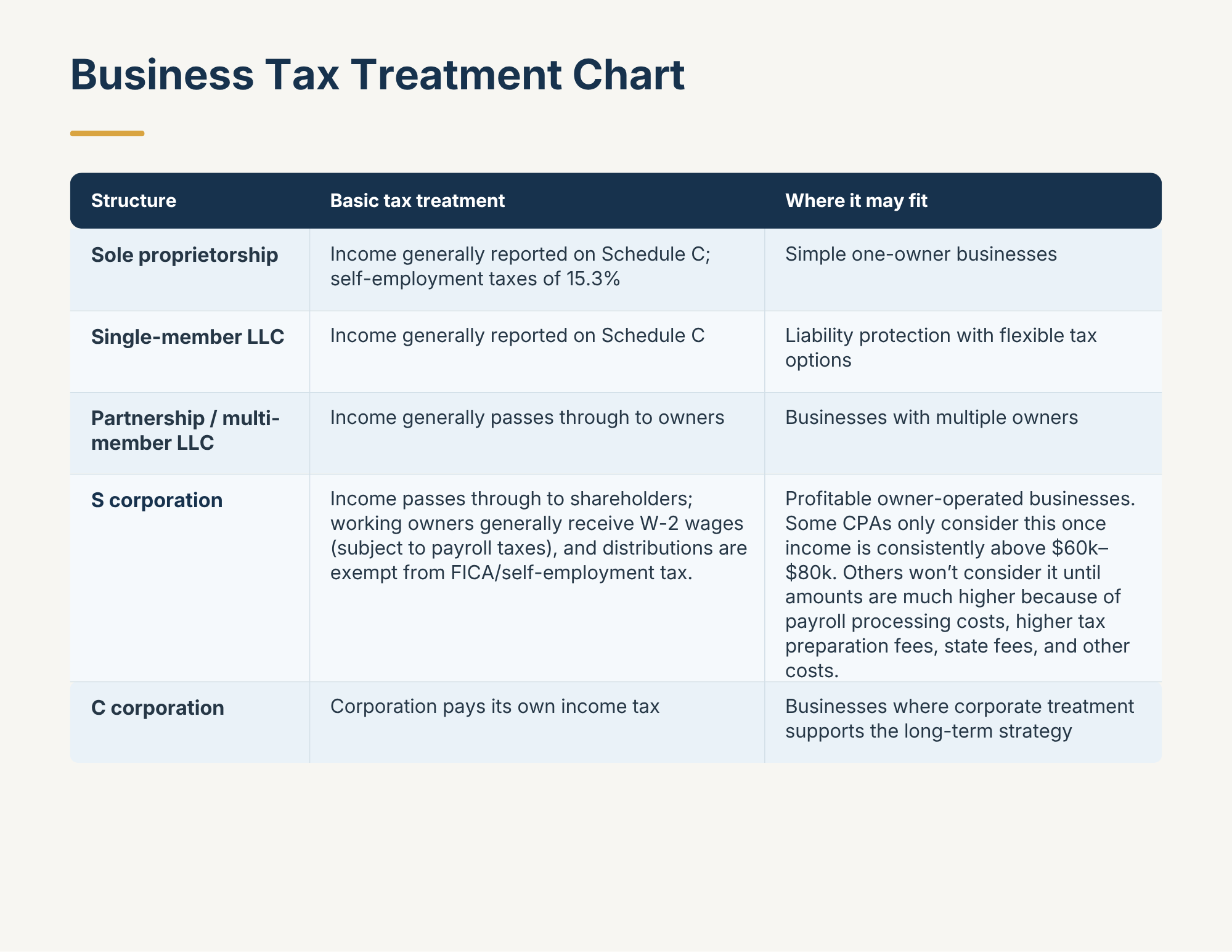
One important distinction: an LLC is a legal structure, not necessarily a federal tax classification. A single-member LLC is generally treated like a sole proprietorship for federal income tax purposes unless it elects another tax treatment.
2. Don't choose an entity based only on the tax rate
Entity choice can involve liability, access to capital, profitability, fringe benefits, number and type of owners, federal and state taxes, payroll taxes, accounting methods, multistate operations and exit strategy.
And pay attention - the entity producing the lowest tax bill this year is not automatically the best entity for building long-term wealth.
3. Pay Yourself - and Reimburse Yourself - Correctly
Once you operate through a corporation, don't treat the company checking account as your personal wallet.
Business mileage, airfare, hotels, professional education, supplies, and the business portion of phone or internet costs are examples of expenses an owner may personally incur. For a corporate owner-employee, an accountable reimbursement plan can provide a cleaner way for the corporation to reimburse properly documented business expenses.
Documentation matters. Establish the process before year-end rather than trying to reconstruct expenses later.
4. Know What's Actually Deductible
A deductible business expense generally needs to be ordinary and necessary. “Ordinary” generally means common or accepted in the business. “Necessary” means appropriate and helpful, not necessarily indispensable.
Common categories can include compensation and benefits, rent, insurance, advertising, professional fees, business travel, certain meals, vehicles, supplies and equipment, repairs and maintenance, interest and certain taxes, retirement-plan contributions, health coverage, technology and software.
But spending $1 does not save $1 in taxes. Example: if a $10,000 deductible expense reduces combined taxes by $3,500, the after-tax cost is still $6,500. Buy something because the business needs it, not merely because it is a write-off.
5. Be Careful With Meals, Entertainment and Travel
Meals, entertainment and travel are commonly misunderstood. Business entertainment is generally not deductible, while qualifying business meals can be subject to limitations and documentation requirements.
A personal vacation does not automatically become business travel because a business conversation occurs during the trip. Document the business purpose, dates, attendees and expenses while the details are fresh.
6. Use Retirement Plans as a Business-Planning Tool
For a successful business owner, the company retirement plan can be a major planning opportunity, and an employee incentive opportunity.
Depending on the company and workforce, options may include a 401(k), safe-harbor 401(k), profit sharing, SEP-IRA, SIMPLE IRA, Solo 401(k), and in appropriate situations defined-benefit or cash-balance arrangements.
I have many clients who are ready to offer plans to their employees. We take time to evaluate their options and costs.
For a high-income owner, the better question is not simply “How much can I put in my 401(k)?” It is “How should the plan be designed around my income, employee demographics, recruiting needs, cash flow and my own personal long-term retirement goals?”
7. Coordinate Equipment Purchases With Your Tax Plan
Equipment, technology, furniture, machinery and certain improvements may qualify for depreciation or expensing provisions. Section 179, bonus depreciation and regular depreciation can recover qualifying costs at different speeds.
Taking the biggest deduction immediately is not always the best answer. Timing can depend on expected future income, tax brackets, state rules and the company's broader capital plan. Run the numbers before making a large purchase primarily for tax reasons.
8. Don't Ignore the Qualified Business Income Deduction
Owners of eligible pass-through businesses may qualify for the Qualified Business Income, or QBI, deduction. The calculation can depend on taxable income, type of business, wages, property and other limitations.
Retirement contributions, depreciation, business expenses and other deductions can change taxable income and potentially affect QBI. This is another reason to model tax strategies together rather than one at a time.
9. Your Employees Create Tax-Planning Opportunities Too
Once a company has employees, taxes and benefits become connected. Retirement plans, health insurance, HSAs, educational assistance, group-term life insurance, reimbursement arrangements, certain fringe benefits and employee-related tax credits may all become part of the planning conversation.
Benefits also affect recruiting and retention. A tax-efficient benefit that employees do not value may not be the best business decision.
And be sure to coordinate your firm’s benefit offerings with your personal needs. For example, I like my clients to have personal disability (income) insurance. The order of obtaining personal insurance, versus offering that benefit via your firm, depends on your particular situation.
10. Multistate Businesses Need Extra Attention
Remote employees and customers in multiple states can create additional income-tax filings, payroll requirements, sales-tax responsibilities and state registrations. Federal entity treatment also does not necessarily determine how every state will treat the business.
Review multistate exposure during the year rather than discovering new filing obligations during tax preparation.
11. Keep Better Records Than You Think You'll Need
Maintain clear records for receipts and invoices, mileage, travel, business meals and their purpose, equipment purchases, payroll, retirement contributions, reimbursements, owner loans, contributions and distributions, contractor payments and professional fees.
Separate business and personal finances. Clean books make tax preparation easier, but more importantly they make planning easier because you can see what the company is earning, spending and retaining.
And work with professional bookkeepers! I see with many of my business owner clients that this aspect of entrepreneurship is among the least ‘fun’ of all. Outsourcing to companies that can help is often a big stress relief.
12. Plan for the Exit Before You're Ready to Exit
Entity structure can affect the tax consequences when you sell assets, sell an ownership interest, bring in a partner, transfer the company to family, sell to employees, establish an ESOP or wind down the business.
If a sale is reasonably possible in the next five to ten years, exit planning belongs in today's tax planning. Waiting until a letter of intent arrives can leave fewer options.
13. Stop Treating Tax Planning as a Once-a-Year Event
Tax preparation looks backward. Tax planning looks forward.
During the year, review compensation, retirement-plan design, estimated taxes, capital purchases, employee benefits and major business changes. Before year-end, project business and personal taxable income and evaluate income, deductions, retirement contributions, depreciation, QBI, payroll, investment income, charitable planning and estimated taxes together.
That is much more useful than hunting for random deductions in December.
The Bigger Picture: Your Business and Personal Wealth Are Connected
Once your company is producing seven figures of revenue, the business tax return is not an isolated document.
Business decisions can affect personal taxes, retirement, investments, cash flow, insurance, estate planning, charitable giving and eventually the owner's exit from the company.
You may have a CPA preparing the return, an attorney handling legal work, a retirement-plan provider running the 401(k), and an insurance professional handling coverage. Someone still needs to look across all of it. That’s where I come into the picture – acting as your personal CFO coordinating all the decisions.
The goal is not simply to pay the least possible tax this year. It is to make smart decisions about how you earn it, keep it, invest it and eventually transfer or enjoy it.
Your business may have outgrown your original tax strategy.
As revenue, profits and personal wealth grow, the decisions around your business become more interconnected.
At Green Bee Advisory, I work with successful business owners to coordinate business tax planning, personal tax strategy, investments, retirement planning and long-term wealth management - so we're looking at the whole picture rather than making decisions in separate silos.
Ready for a more coordinated approach to your business and personal wealth?
The information presented here is for education purposes only. Each business and owner have different needs, goals, and objectives and should always consult a qualified tax professional before enacting any tax strategies. Green Bee Advisory LLC and LPL Financial do not provide legal advice or tax services. Please consult your legal advisor or tax advisor regarding your specific situation.